












What is Banking Organization Theory?
Most people may think of “cash money (coins and bank notes)” when they hear the term “money.” However, cash money is only a portion of money. There are many things that cannot be revealed solely on cash money. Banking institutional theory, which is my research field, involves research of banks. Banking services are provided by an “organization” comprised of people such as a president, directors and bank clerks rather than objects such as cash money. This perspective was previously absent in monetary theory, but I believe that the structure of the financial system cannot be clarified without it. This is because deposit money is at the core of the financial system to a greater degree than cash money is, and that is something developed throughout organizations called banks. It is necessary to thoroughly study about the financial infrastructure which is created by banking institutions.Research of Central Banking System
Central banks in respective countries play the most important roles among financial institutions. For instance, it is the Bank of Japan that serves this role in Japan. In Europe, the European Central Bank functions across borders. These are certainly organizations integrating a president, directors and thousands of bank clerks. As most research related to central banks focused only on the macro-monetary policy up to now, I consider my role to be to thoroughly clarify central banking from the standpoint of organizational theory. Incidentally, I have worked for the Bank of Japan for 30 years. Based on this experience, I attempt to find out about realistic functions by actually going onsite and coming into direct contact with the objective of my research. My research method is similar to “participant observation,” which is adopted in researches such as that of archaeology and anthropology. Through actual onsite experience, I am investigating various aspects of the central banks such as their optimal governance structure and settlement systems provided by the central banks.Toward Establishing a Common Currency in Asia
Why is it necessary to study about central banking systems? One of the major objectives is the establishment of a common currency in Asia. The European Central Bank has already been established and the common currency called the “euro” has been created in Europe. It is necessary to consider what type of systems should be established in Asia. Developing a common currency does not merely involve the cash money. It requires establishing an organization of a central bank that will function beyond borders. In other words, it refers to considerations about kinds of organizational structuring, how to establish an optimal currency area, how settlement systems should be linked between central banks in respective countries and designing of what kind of governance structure is to be established. It is not only a matter of monetary issue, as political and diplomatic issues must also be taken into consideration in broad terms. Several problems regarding the euro have to be resolved such as fiscal deficits and regional differences in the euro area. Despite serious problems facing the euro, I basically consider myself to be a “euro optimist” and am hopeful about its future prospects. On the whole, the euro is certainly a strong and stable currency in any case and has a proven track record of increasing the economic growth in Europe. Above all, what is more important than economic development is the intention to establish the euro in order to “never cause war in Europe.” Sharing a common currency means advancing the relationships of economic mutual dependence that will enhance peace in the region. This is a major reason why I consider it necessary to integrate currencies in the Asian region as well. In order to integrate currencies, we must establish the Asian Central Bank.To Become Personnel Capable of Taking Action in Organizations
Although I repeat myself, I believe the most important aspect of learning monetary theory is to consider the perspective of the “organization.” People often think that monetary theory is a scholarly pursuit of handling numbers and numerical formula, but it is actually people who take action and mutually cooperate to establish financial systems. Anyone who studies monetary theory also needs to join an organization and gain the experience of taking action with an organization rather than refining knowledge as an individual. To build such experience, I believe working in Japan is significant. Japanese companies, not only the banking industry, are consortiums that put major emphasis on collaboration. I expect foreign students to also learn about the Japanese organizational system to acquire the essence of what a Japanese company is.Profile
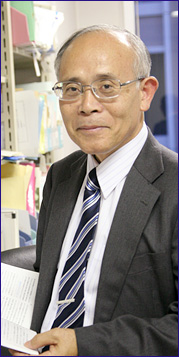
Professor of Department of Commerce specialized in Banking Organization Theory.1948 Born in Toyama
1972 Graduated from Kanazawa University, B.A. in Economics; joined the Bank of Japan
1982-1984 Visiting Scholar at the Department of Economics, University of Minnesota
1995 Senior Adviser, Asian Central Bank Cooperation, International Department, the Bank of Japan
1999 Deputy Director-General, Financial System Department, Bank of Japan
2002 Professor, Department of Commerce, Meiji University (currently)
2008 Independent Director, ATM Japan Ltd. (currently)
Main Publications and Research Papers
“The Governance Structure of the Central Bank,” The Bulletin of the Faculty of Commerce, Meiji University, March 2004“Globalization of Central Bank Payment and Settlement Systems,” The Bulletin of the Faculty of Commerce, Meiji University, March 2009
“Involvement of Central Banks for Developing Payment Systems in the East Asia,” The Monthly Kinyu Journal, December 2009
“Public Governance of Central Banks,” BIS working paper, March 2010
“The Ownership Theory of Prudential Policy,” The Bulletin of the Faculty of Commerce, Meiji University, February 2011


