


カリキュラム編成
【基幹科目群】
政策科学科目群(A群)
国際政策科目群(B群)
公共経営科目群(C群)
法律技術科目群(D群)
【応用科目群】
政策分野研究(G群)
特別・特殊研究(H群)
英語コース
公共政策プログラム
国際開発政策プログラム
コミュニティ・マネジメント・プログラム
【英語コース科目群】
開発政策・経済科目(E群)
・Macro Economics
・Growth Theory & Development
・Quantitative Analysis of Economic Policy
・International Economics & Finance
・Economic Cooperation
・Politics and Economics in East Asia
・Government and Politics in
Middle East and Africa
・Micro Economics
・Planning for Macroeconomic Policy
・Fiscal Policy and Development
・International Investment
・Politics and Development
・Economic Development
・Japanese Economy in
International Environment
環境・コミュニティ政策科目(F群)
・Environmental Policy
・International Law of Environment
・Resource Management
・Community Policy and Management
・NPO/NGO Study
・Risk Management
・Disaster Recovery and Rehabilitation
・Crisis and Contingency Management
・Crisis Management and
Public Administration
Industrialization
・Environment and Economics
・Urban Management & Environment
・Environmental Assessment
・Regional Planning
・Social Development
・Human Resource Management
・Crisis Management
・Crisis Management and Leadership
・Community Development and
Industrialization
科目編成の考え方と特色
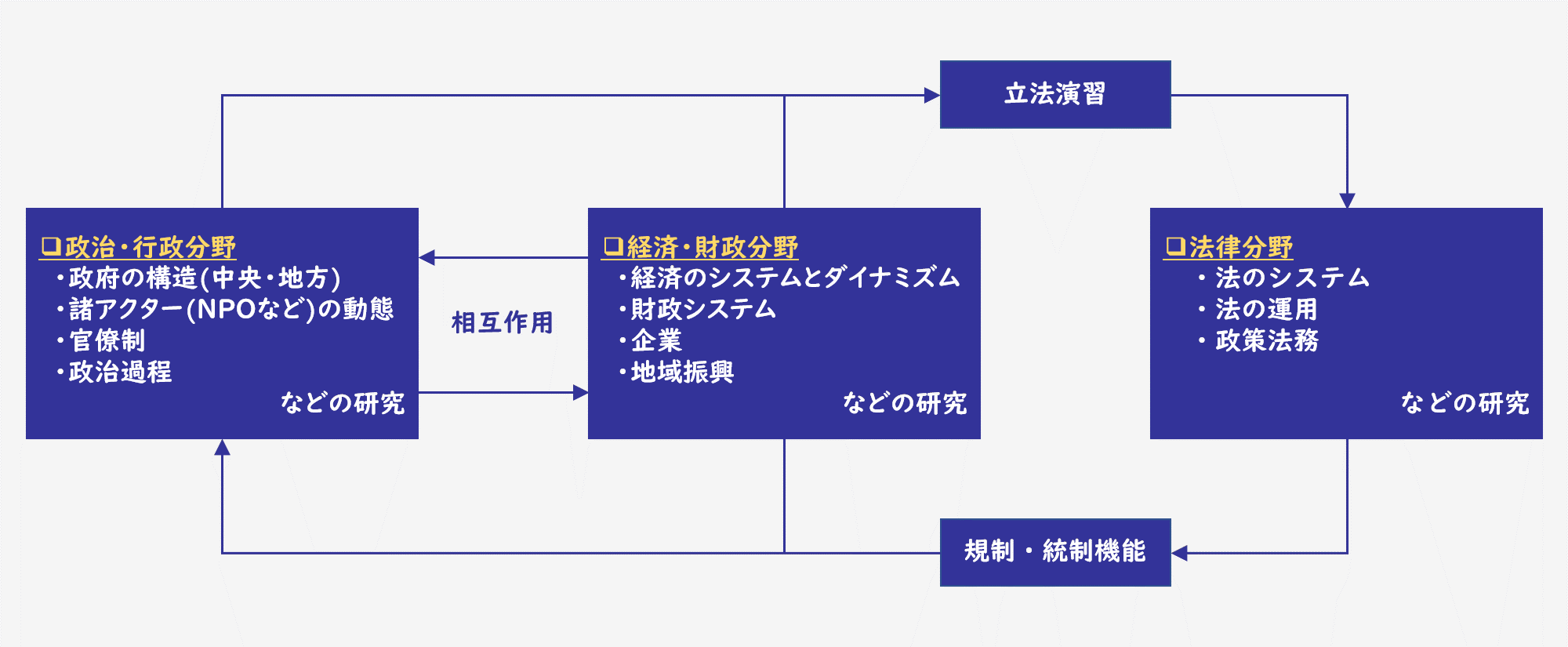
その背景には、政策の展開過程における政治・行政学的見地、法律的一貫性、経済学的能率性等、一連の知識・知見の重要性が高まっていること、環境・資源問題等、国際的見地からの専門能力も一層肝要となります。
学問領域としては,政治・行政,経済・財政,法律の3分野を上記の基幹科目群A~D群に配置するとともに,それらの具体的な現状を把握,理解するための応用科目群に政策分野研究科目(G群)を豊富に配置し,ガバナンスをめぐる諸相を理解することができるようにします。さらに、政策の対外発表能力涵養、公共政策分野における基本的なスキルアップのための演習科目をH群(特別・特殊研究)として用意しています。
このような科目編成に加え、授業において「ケーススタディズ(CASESTUDY)」を重視し、「議論・討議(DISCUSSION)」を重ね、「フィールドワーク(FIELD WORK)」等の現場体験的な要素を取り入れ、それらの成果を「体系化(SYNTHESIS)」してゆく、「C・D・F・S」を重視した授業展開により、高度職業人としての広い視野と個別具体的な実践を結合させる人材育成を目指しています。

科目編成の考え方と特色