


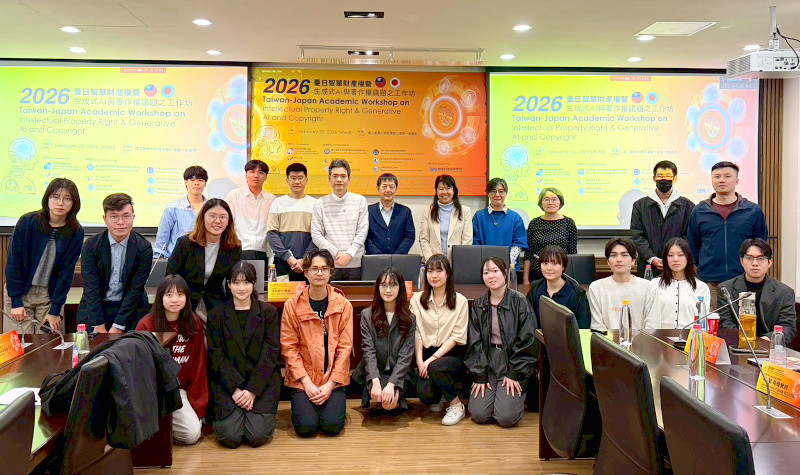
IMAMURA Tetsuya seminar, the School of Information and Communication, conducted an overseas study program in Taiwan from February 23 to 26, and on the 25th, held a workshop titled “Taiwan-Japan Workshop on Intellectual Property Rights, Generative AI, and Copyright” at the National Taiwan University. The workshop was organized with the aim of enabling students from Japan and Taiwan to share the latest knowledge and challenges regarding intellectual property law and generative AI, thereby deepening mutual understanding.
During the morning session, students gave presentations. TANAKA Rei, FURUYA Hiroki, and OTA Shuhei (all third-year students) from the IMAMURA seminar presented on the theme “How to Survive in the Information Society! Basics of Intellectual Property Learned in 1 Minute.” In addition, students from the National Taiwan University and National Taipei University presented on the latest issues regarding generative AI, fair use, assessment of an inventive step under patent law, AI voice conversion technologies, and related topics. A lively question-and-answer session took place following feedback from Taiwanese intellectual property law experts, including Professor Su-Hua Lee of the National Taiwan University.
In the afternoon session, Professor IMAMURA delivered a lecture titled “The Legal Defense of Voice in the AI Era” and a discussion was held with researchers and practitioners.
Professor IMAMURA commented on the workshop, saying “It was an opportunity that made me feel the potential for further development of educational and research exchanges between Japan and Taiwan through the shared challenge of generative AI.”
In addition, during their fieldwork, the seminar students visited the Chiang Kai-shek Memorial Hall, Longshan Temple, and Taipei 101, deepening their understanding of Taiwan’s history, culture, and social context. Through academic discussions and cultural experiences, the four-day program broadened their international perspectives and allowed them to experience comparative legal thinking firsthand.