


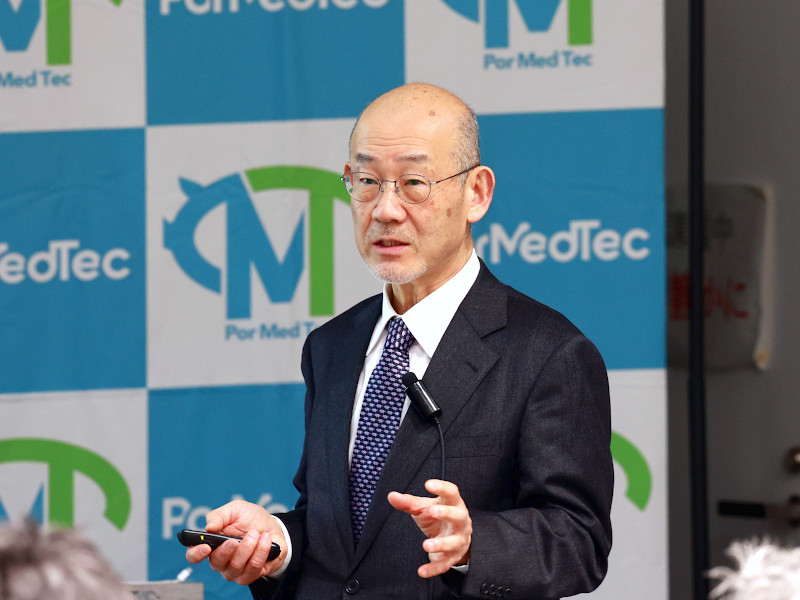
Professor NAGASHIMA delivering a lecture
On February 15, Meiji University co-hosted a public symposium titled “Expectations for the clinical application of xenogeneic kidney transplantation and the associated social challenges” with PorMedTech Co., Ltd., a startup spun off from Meiji University, at the Surugadai Campus. The event was attended by 120 people, including medical professionals, patients with kidney failure, their families, and members of the media.
In Japan, the average waiting time for a kidney transplant is approximately 15 years owing to a shortage of donors, as a result, developments in xenogeneic kidney transplantation are attracting attention as a potential option for improving the quality of life for patients undergoing dialysis. Xenogeneic kidney transplantation is a procedure in which a pig’s kidney — genetically modified to prevent rejection — is transplanted into a human recipient. Companies such as eGenesis in the United States are advancing clinical applications of this technology and have successfully weaned two patients off dialysis for 24 weeks.
At our university, the Meiji University International Institute for Bio-Resource Research, which was established by Professor NAGASHIMA Hiroshi of the School of Agriculture and for which he served as the first director, has been conducting research and development on the production and breeding of donor pigs. PorMedTech, led by Professor NAGASHIMA as CEO, has successfully produced cloned donor pigs domestically for clinical applications, the same pigs used by eGenesis, raising the possibility that clinical applications could become a reality in Japan as well. This symposium was held to make the latest information surrounding xenogeneic kidney transplantation publicly available.
In Part 1, in addition to Professor NAGASHIMA, lectures were delivered by Mr. KAWAI Tatsuo (Professor of Surgery at Harvard Medical School), who performed xenogeneic kidney transplant surgery at Massachusetts General Hospital; Mr. TANABE Kazunari (Director, Kidney Transplant and Robotic Surgery Center, Tokushukai Shonan Kamakura General Hospital); Mr. HOTTA Kiyohiko (Associate Professor, Graduate School of Medicine, Hokkaido University); and Ms. KAMISATO Ayako (Director, Department of Medical Affairs and Health Policy, National Center for Child Health and Development). They discussed the characteristics of genetically modified donor pigs, previous cases in the United States, the current organ shortage, expectations for improving the quality of life for dialysis patients, and social challenges surrounding clinical application. During the panel discussion in Part 2, a question-and-answer session was held with participants. This provided an opportunity for medical professionals, patients, and the general public to share their perspectives on the current status and key issues regarding the clinical application of xenogeneic kidney transplantation.

≪Japanese version≫