


[Graduate School of Global Governance] Prof.Kimura's full paper has been published in PGR (Policy and Governance Review)
Mar. 05, 2026
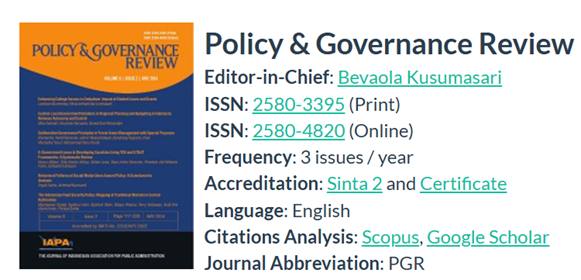
Professor Shunsuke Kimura's full paper has been published in PGR (Policy and Governance Review): PGR is affiliated with the Indonesian Association for Public Administration (IAPA), which collaborates with the Asian Association for Public Administration (AAPA), the Eastern Regional Organization for Public Administration (EROPA), and the Asian Group of Public Administration (AGPA).
The title:'The change in Japanese dual representative system caused by social media: Technological Innovation vs. Traditional Governance: Striking a balance'
This study addresses the question: How is the advancement of social networking services (SNS) affecting changes in the dual representative system of local government in Japan? It posits the following hypotheses: Social media has influenced the Japanese dual representative system in two ways: by promoting theatrical political behavior and by bringing about an agonistic democracy. The political phases can be divided into two categories: (a) theatrical political behavior (political action and direct requests) and (b) agonistics democracy in the check and balance system (Veto, Non-confidence and Provisional decision). They are evolving in response to citizens’ desires for direct policy control and the emergence of theatre democracy. Furthermore, the current analysis suggests that the widespread use of social media has coincided with significant changes in the operation of the dual representative system and that social media has significantly influenced these changes. Agonistic democracy emphasizes conflict and discord over coordination and consensus building, viewing them as essential to democratic vitality. This perspective, when combined with the rapid dissemination of emotionally charged information, tends to facilitate theatricalized political actions and results in polarized, conformist political behavior, wherein assembly members often face pressure to engage in politically aligned action. Considering these challenges to the dual representative system, this study proposes several measures for assemblies, assembly members, and citizens to respond to the influence of social media. First, assemblies must guard against monolithic entities in the face of incentives for agonistic political action, which are facilitated by social media. They should remain aware of their role as forums for diverse opinions in which both majority and minority voices coexist. Second, individual council members should acknowledge their vulnerabilities in issue formation. Even in the face of social media-driven peer pressure, they must engage in issue formulation within the assembly as a reflection of representative democracy, developing resilience to resist pressures that favor theatrical democracy. Third, in an era where social media is pervasive, citizens must recognize the imperative to engage in rational discourse that enables informed public decision-making while scrutinizing public discourse to avoid being swept up in inflammatory rhetoric.