


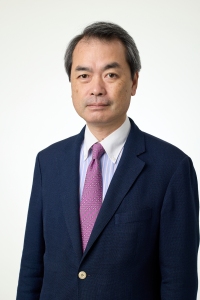
 Dean YUASA Harumichi
The Graduate School of Governance Studies) was established in April 2004 and transformed to the professional degree program (professional graduate school) starting in the 2007 academic year.
Looking back at the social environment at that time, it is evident that the period surrounding the establishment of the Graduate School of Governance Studies coincided with a time of significant upheaval in Japan's administration, politics, and economy.
In 2001, a reorganization of central government ministries and agencies was implemented to eliminate the drawbacks of vertical administrative divisions, strengthen cabinet functions, and improve the efficiency of administrative affairs and operations. Furthermore, in 2000, the Comprehensive Decentralization Act was enacted, transferring administrative responsibilities and authority from the national government to local public entities, and from prefectures to municipalities. Meanwhile, in the economic sphere, a financial crisis emerged after 1997, leading to a series of failures among major financial institutions. In the United States, surprising and serious accounting fraud scandals occurred: the Enron scandal in 2001 and the WorldCom scandal in 2002, leading to a global call for strengthened corporate governance.
Against this backdrop, the Graduate School of Governance Studies was established. It serves as a forum to explore mechanisms for achieving objectives and sustaining long-term social development through collaboration among diverse stakeholders and parties, rather than placing the responsibility for solving various challenges solely on “government (national and local authorities).”
Over 20 years have passed since then, and the concept of governance itself has diversified. Yet, the need to establish and strengthen governance persists across all domains. It is no exaggeration to say that hardly a day goes by without news featuring the keyword “governance.” This underscores the necessity of exploring governance as a mechanism for the long-term maintenance and development of society.
Today, our graduate school has produced over 1,000 graduates. Many are involved in the “governance” of communities and economies—serving as local government officials or mayors, as members of local or national assemblies, as employees of private companies, or as members of NPOs and local communities.
Furthermore, our graduate school established the International Public Policy Course (English Track), welcoming civil servants and staff from related organizations, primarily from Asian countries. Graduates are now active as senior civil servants in their nations. The Graduate School of Governance Studies is a place where diverse individuals responsible for governance come together to learn and research, creating new frameworks for solving contemporary societal challenges and managing society. We hope to welcome you to this unique “place for exploring governance.” We wish for you to become a member of the “Governance Family,” tackling the complex challenges facing modern society as a professional and contributing to building a better future.
Dean, Graduate School of Governance Studies - Public Policy School -
YUASA Harumichi