

[School of Global Japanese Studies](Kishi seminar) Meiji University × Istanbul University: Exploring School Education Experiences through ABR
Jan. 09, 2026
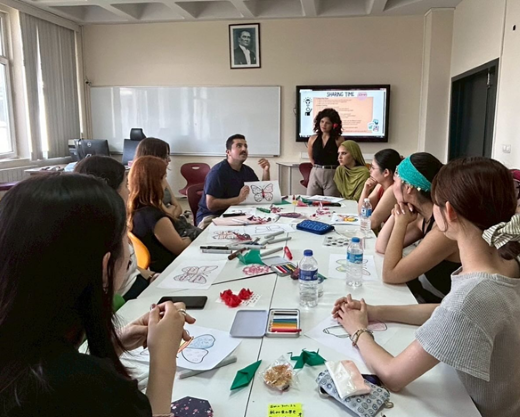
NANJYO Ayane from Meiji University, along with Bayza and Shamir from Istanbul University, conducted Arts-Based Research (ABR) as part of an international collaborative learning initiative. A total of 11 students from both universities participated in this activity, deepening their inquiry by drawing on their respective experiences in Japanese and Turkish school education as subjects.
Participants reflected on their educational journeys through elementary, junior high, high school, and university, sharing their individual perspectives on relationships with teachers, attitudes toward evaluation, involvement with religion, and ways of interacting with others. The focus was not on comparing educational systems or facilities, but on dialogue starting from personal experiences.
Through these discussions, they shared how their experiences shaped their career paths and values, identifying common questions and differing perspectives that transcended national and cultural boundaries.
This practice, as one example of international collaborative research among students, demonstrated new possibilities for ABR in exploring education and culture across cultures. Furthermore, it provided an opportunity to understand the practice of education within its broader cultural, social, historical, and political contexts.
You can see the video from here.(Please click)
Below are reports from the project implementers.
◾️Ayano NANJYO (4th year student, Kishi Seminar)
This project originated when my student partner from Istanbul University and I shared our school education experiences. What particularly stood out was our shared sense of suffocation regarding “school rules.” We realized we felt similarly about environments demanding uniform, military-like behavior.
However, the nature of that “rigidity” differed significantly. At my Japanese junior high school, emphasis was placed on external appearance regulations like hair length, skirt length, and shoe color. In contrast, at her Turkish high school, security guards were constantly stationed, leaving the campus was prohibited, and only male students were permitted to leave during Friday prayers. We realized that even though we shared the same feeling of “suffocation,” the underlying cultural and religious factors were different.
We planned this project to explore these similarities and differences, and how they influence who we are today. Using butterflies as a motif, and employing words, shapes, and colors to express our experiences at each educational stage, we thought we could connect past experiences and visualize how our “present selves” were formed. I aimed to explore the impact of education on the individual through art, including aspects that language alone cannot fully capture.
Simply comparing educational systems could be done through the internet or AI-based research. However, I believe the significance of this project lies in exploring personal, internal experiences through visual art and comparing them. This allows us to re-examine education from social, cultural, and structural perspectives as a tangible, lived experience.
◾️Beyza(4th year student, the faculty of education)※translated by Ayane NANJYO
This study employed a butterfly figure to represent the four stages of schooling—elementary, middle, high school, and university—through colors or words chosen by students. Participants were free to express their feelings symbolically, allowing personal reflection on their educational journeys.
Findings revealed recurring patterns across countries, yet also notable cultural contrasts. Turkish participants often associated primary school with pink tones, symbolizing purity and childhood innocence. In contrast, Japanese participants described primary school as a stricter, more disciplined stage shaped by continuous homework, despite its potential for playfulness.
In later stages of schooling, both similarities and differences emerged. While students from Turkey and Japan—coming from distinct cultural backgrounds—sometimes expressed overlapping emotions, they also reflected diverging perspectives rooted in cultural or school-specific practices. For instance, for some students, middle school was expressed with darker colors, such as black, symbolizing a more exhausting and challenging period.
This study revealed that, despite coming from different cities and cultural contexts, many participants shared common emotional patterns in their educational journeys, while others reflected differences shaped by their national or institutional culture. However, since the study involved only 11 participants, it is expected that a larger group would provide deeper and more varied insights.
≪Japanese version≫
Participants reflected on their educational journeys through elementary, junior high, high school, and university, sharing their individual perspectives on relationships with teachers, attitudes toward evaluation, involvement with religion, and ways of interacting with others. The focus was not on comparing educational systems or facilities, but on dialogue starting from personal experiences.
Through these discussions, they shared how their experiences shaped their career paths and values, identifying common questions and differing perspectives that transcended national and cultural boundaries.
This practice, as one example of international collaborative research among students, demonstrated new possibilities for ABR in exploring education and culture across cultures. Furthermore, it provided an opportunity to understand the practice of education within its broader cultural, social, historical, and political contexts.
You can see the video from here.(Please click)
Below are reports from the project implementers.
◾️Ayano NANJYO (4th year student, Kishi Seminar)
This project originated when my student partner from Istanbul University and I shared our school education experiences. What particularly stood out was our shared sense of suffocation regarding “school rules.” We realized we felt similarly about environments demanding uniform, military-like behavior.
However, the nature of that “rigidity” differed significantly. At my Japanese junior high school, emphasis was placed on external appearance regulations like hair length, skirt length, and shoe color. In contrast, at her Turkish high school, security guards were constantly stationed, leaving the campus was prohibited, and only male students were permitted to leave during Friday prayers. We realized that even though we shared the same feeling of “suffocation,” the underlying cultural and religious factors were different.
We planned this project to explore these similarities and differences, and how they influence who we are today. Using butterflies as a motif, and employing words, shapes, and colors to express our experiences at each educational stage, we thought we could connect past experiences and visualize how our “present selves” were formed. I aimed to explore the impact of education on the individual through art, including aspects that language alone cannot fully capture.
Simply comparing educational systems could be done through the internet or AI-based research. However, I believe the significance of this project lies in exploring personal, internal experiences through visual art and comparing them. This allows us to re-examine education from social, cultural, and structural perspectives as a tangible, lived experience.
◾️Beyza(4th year student, the faculty of education)※translated by Ayane NANJYO
This study employed a butterfly figure to represent the four stages of schooling—elementary, middle, high school, and university—through colors or words chosen by students. Participants were free to express their feelings symbolically, allowing personal reflection on their educational journeys.
Findings revealed recurring patterns across countries, yet also notable cultural contrasts. Turkish participants often associated primary school with pink tones, symbolizing purity and childhood innocence. In contrast, Japanese participants described primary school as a stricter, more disciplined stage shaped by continuous homework, despite its potential for playfulness.
In later stages of schooling, both similarities and differences emerged. While students from Turkey and Japan—coming from distinct cultural backgrounds—sometimes expressed overlapping emotions, they also reflected diverging perspectives rooted in cultural or school-specific practices. For instance, for some students, middle school was expressed with darker colors, such as black, symbolizing a more exhausting and challenging period.
This study revealed that, despite coming from different cities and cultural contexts, many participants shared common emotional patterns in their educational journeys, while others reflected differences shaped by their national or institutional culture. However, since the study involved only 11 participants, it is expected that a larger group would provide deeper and more varied insights.
≪Japanese version≫