


From April 2025, the Kishi Seminar began an international exchange program with students from Aleppo University in Syria via the internet. Through our ongoing exchanges, we strongly felt that the country of “Syria” cannot be fully understood solely through the images reported in Japan.
Negative aspects like civil war and refugees are certainly part of Syria's reality. Yet, on the other hand, there exists a peaceful everyday life and young people living with hope for the future—aspects rarely conveyed in the news. Driven by the desire to “share the real Syria, not just civil war and refugees,” a joint project between Kishi Seminar students and Aleppo University students began.
Below is a report from Ena MURAHASHI and Riho MINAMI, sixth-year students of the KISHI Seminar, who participated in this project.
■Beyond the News
When people hear “Syria,” many likely picture news videos of civil war and refugees. The civil war, which lasted from 2011 to 2024, was repeatedly reported in Japan, strongly shaping perceptions of Syria. However, what we know through the media represents only a small part of daily life in Syria.
In 2024, while studying abroad in Toronto and Vancouver, Canada, we met several students originally from Syria. Despite their unfamiliar surroundings, their unwavering smiles and dedication to learning English were remarkably positive, profoundly challenging our preconceived notions of Syria. This encounter became the starting point for our research.
We set our research goal as “conveying the ‘real Syria’ that falls through the cracks of reporting, beyond just aspects like civil war and refugees.” We then collaborated online with students from Aleppo University, located in a northern Syrian city that was once a fierce battleground during the civil war, to implement the “Syria Photovoice Project.”
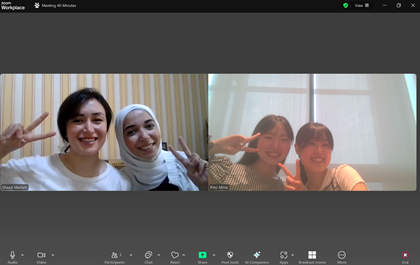
Four students from Aleppo University (Ghazal, Zain, Fatima, and Yashiro), who study Japanese and have an interest in art, volunteered to participate in this project.
▶︎Photo: Online exchange session
■The Photovoice Method
We adopted the “Photovoice” approach. Photography is an accessible form of expression, and it's a medium that intuitively conveys what moved the photographer and where they found meaning. We believed Photovoice would be highly effective for sharing experiences through the participants' own perspectives.
We asked participating students to freely photograph “moments that moved them” in their daily lives and to summarize their thoughts at that time in a short term. We placed particular importance on giving absolutely no instructions, like “Take photos like this.” By entrusting everything—composition and theme—entirely to them, we aimed to receive the “unfiltered gaze” of young people living in Syria directly.
Furthermore, since participating students expressed a desire to “try expressing their feelings in Japanese,” this Photovoice project was produced entirely in Japanese. This is one effort to make it feel more relatable for Japanese readers.
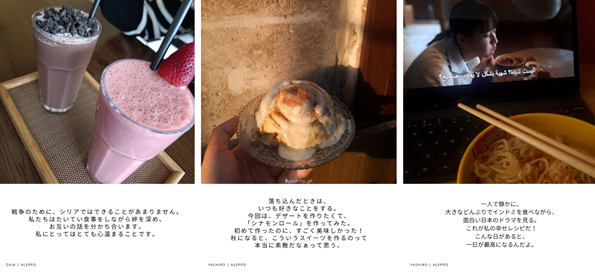
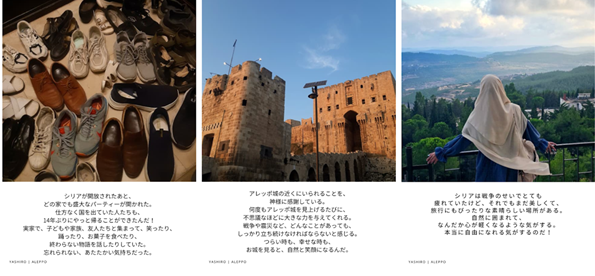
The photovoice they submitted did not solely reflect the “shadow of war.” What emerged was the utterly natural everyday life: time spent with family and friends, the joys and worries of being a student.
Images of enjoying chats with friends at cafes, celebrating birthdays together, and immersing themselves in personal hobbies. These scenes were indistinguishable from those of Japanese university students. The photos breathed life into the real lives of Syrian youth—lives unseen in news articles alone.
Even more striking was how post-Civil War Syria radiated hope, not the gloom and despair we might imagine. The photos and words conveyed the joy of being with family and friends, and a powerful resolve: “Let's rebuild Syria together once more.”
▶︎Photo: Selected photovoice from the Girls' House
■Through the Diversity Festa Exhibition
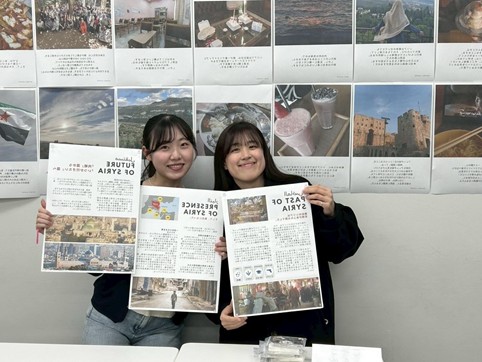
These Photovoice were exhibited at the Diversity Festa held at Meiji University's School of Global Japanese Studies on November 30, 2025.
At the venue, many students naturally stopped to engage with the photos and words, connecting with the daily lives and thoughts of Aleppo University students. Many students who saw the exhibition shared comments like, “It made me want to visit Syria someday.” Their interest was sparked by the sense of peaceful daily life, beautiful nature, and the positive attitudes of the people conveyed through the photos. Others expressed surprise, noting that Syria—a country they had perceived as “far away”—had students their own age who were interested in Japanese culture and studying the Japanese language.
For many Japanese students, Syria may have previously held a strong image as a “country with civil war, dangerous, and distant.” However, what Photovoice captured were young people living daily lives filled with hope and joy, lives no different from our own. A country that felt psychologically and physically distant transformed into a place that felt close and somewhere they wanted to visit.
Through this project, we were able to connect with the resilience and inherent beauty of the Syrian people, aspects often obscured by the media information we typically encounter. We were also reminded of the immense power of photography, a familiar medium, as a tool for conveying these messages.
We sincerely hope this initiative serves as an opportunity for parents, high school students, and university students to broaden their perspective on the world.
▶︎Photo: Ena Maruhashi and Riho Minai, participants in the exhibition and project at Diversity Festa
▶︎Photovoice works can be viewed on the Kishi Seminar webpage.
Negative aspects like civil war and refugees are certainly part of Syria's reality. Yet, on the other hand, there exists a peaceful everyday life and young people living with hope for the future—aspects rarely conveyed in the news. Driven by the desire to “share the real Syria, not just civil war and refugees,” a joint project between Kishi Seminar students and Aleppo University students began.
Below is a report from Ena MURAHASHI and Riho MINAMI, sixth-year students of the KISHI Seminar, who participated in this project.
■Beyond the News
When people hear “Syria,” many likely picture news videos of civil war and refugees. The civil war, which lasted from 2011 to 2024, was repeatedly reported in Japan, strongly shaping perceptions of Syria. However, what we know through the media represents only a small part of daily life in Syria.
In 2024, while studying abroad in Toronto and Vancouver, Canada, we met several students originally from Syria. Despite their unfamiliar surroundings, their unwavering smiles and dedication to learning English were remarkably positive, profoundly challenging our preconceived notions of Syria. This encounter became the starting point for our research.
We set our research goal as “conveying the ‘real Syria’ that falls through the cracks of reporting, beyond just aspects like civil war and refugees.” We then collaborated online with students from Aleppo University, located in a northern Syrian city that was once a fierce battleground during the civil war, to implement the “Syria Photovoice Project.”
Four students from Aleppo University (Ghazal, Zain, Fatima, and Yashiro), who study Japanese and have an interest in art, volunteered to participate in this project.
▶︎Photo: Online exchange session
■The Photovoice Method
We adopted the “Photovoice” approach. Photography is an accessible form of expression, and it's a medium that intuitively conveys what moved the photographer and where they found meaning. We believed Photovoice would be highly effective for sharing experiences through the participants' own perspectives.
We asked participating students to freely photograph “moments that moved them” in their daily lives and to summarize their thoughts at that time in a short term. We placed particular importance on giving absolutely no instructions, like “Take photos like this.” By entrusting everything—composition and theme—entirely to them, we aimed to receive the “unfiltered gaze” of young people living in Syria directly.
Furthermore, since participating students expressed a desire to “try expressing their feelings in Japanese,” this Photovoice project was produced entirely in Japanese. This is one effort to make it feel more relatable for Japanese readers.
The photovoice they submitted did not solely reflect the “shadow of war.” What emerged was the utterly natural everyday life: time spent with family and friends, the joys and worries of being a student.
Images of enjoying chats with friends at cafes, celebrating birthdays together, and immersing themselves in personal hobbies. These scenes were indistinguishable from those of Japanese university students. The photos breathed life into the real lives of Syrian youth—lives unseen in news articles alone.
Even more striking was how post-Civil War Syria radiated hope, not the gloom and despair we might imagine. The photos and words conveyed the joy of being with family and friends, and a powerful resolve: “Let's rebuild Syria together once more.”
▶︎Photo: Selected photovoice from the Girls' House
■Through the Diversity Festa Exhibition
These Photovoice were exhibited at the Diversity Festa held at Meiji University's School of Global Japanese Studies on November 30, 2025.
At the venue, many students naturally stopped to engage with the photos and words, connecting with the daily lives and thoughts of Aleppo University students. Many students who saw the exhibition shared comments like, “It made me want to visit Syria someday.” Their interest was sparked by the sense of peaceful daily life, beautiful nature, and the positive attitudes of the people conveyed through the photos. Others expressed surprise, noting that Syria—a country they had perceived as “far away”—had students their own age who were interested in Japanese culture and studying the Japanese language.
For many Japanese students, Syria may have previously held a strong image as a “country with civil war, dangerous, and distant.” However, what Photovoice captured were young people living daily lives filled with hope and joy, lives no different from our own. A country that felt psychologically and physically distant transformed into a place that felt close and somewhere they wanted to visit.
Through this project, we were able to connect with the resilience and inherent beauty of the Syrian people, aspects often obscured by the media information we typically encounter. We were also reminded of the immense power of photography, a familiar medium, as a tool for conveying these messages.
We sincerely hope this initiative serves as an opportunity for parents, high school students, and university students to broaden their perspective on the world.
▶︎Photo: Ena Maruhashi and Riho Minai, participants in the exhibition and project at Diversity Festa
▶︎Photovoice works can be viewed on the Kishi Seminar webpage.
http://m-kishi.com/seminar/outputs/web-news/